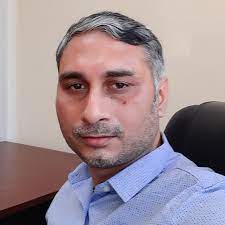
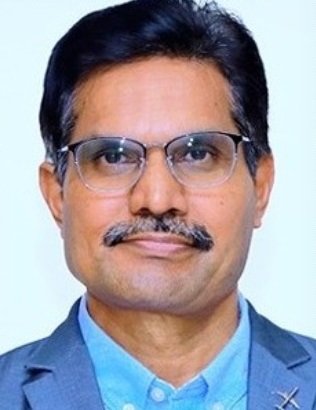
Laltu Chandra received Ph.D. from the University of Karlsruhe (now KIT) Germany in 2005. Subsequently, he served as a visiting scientist at IGCAR Kalpakkam, India, as an ANR post-doctoral fellow at INP Grenoble, France, as an R & D consultant at NRG Petten, The Netherlands, and as a faculty member at IIT Jodhpur and IIT (BHU) Varanasi. Currently, he is a Professor at IIT Kanpur. His research interests include the application of fluid flow and heat transfer for (a) designing solar thermal sub-systems for metals processing and hydrogen generation, (b) developing correlations for nanofluid flow, and assessment of heat transfer fluids for solar thermal applications, and (c) investigating the transport and deposition of dust on solar thermal sub-systems. The findings are reported in more than 95 peer-reviewed international journals, book chapters, and conference proceedings.
Dr. S. Velmurugan is presently working as Chief Scientist and Head, Traffic Engineering and Road Safety Divsion at CSIR - Central Road Research Institute (CRRI), New Delhi. He has completed his Ph.D. in Transportation Systems Engineering at IIT, Bombay in March, 1995.
He possesses more than about 29 years of experience in traffic engineering, road safety and transportation planning and transport economics. He was instrumental in the formulation / revision of 18 IRC publications during the last 12 years. He has served in the capacity of Project Leader / Coordinator in the World Bank sponsored projects as well as National Highways Authority of India (NHAI) and various state Public Works Departments (PWD) projects for the conduct of various stages of Road Safety Audits (RSA) covering more than 9000 Kms. He is acting as the Joint Course Coordinator for the most sought after course by the Highway and Transportation fraternity in the country being run by CSIR - CRRI since May, 2017 namely, 15-day Certification Course on "Road Safety Audit and Other Road Safety related Aspects"
He has published more than 150 technical papers in International and National journals / Conferences and presented in more than 60 research forums.
Dr. Hitesh Shrimali is an Associate Professor in the School of Computing and Electrical Engineering (SCEE), Indian Institute of Technology Mandi (IIT Mandi). He received the B.E. degree in Instrumentation engineering from the Nirma Institute of Technology, Ahmedabad, the M.Tech. degree in Instrumentation engineering from IIT-Kharagpur and the Ph.D. degree in analog and mixed-signal VLSI design from IIT-Delhi. He was with the Analog and Mixed-Signal Group, TRnD Department, STMicroelectronics from Aug’11 to Jun’13. From Jun’13 to Dec’14, he was a Post-Doctoral Researcher with the University of Milan. His current research interests include design and testing of radiation hard circuits (particle detectors and PET scanners), data converters (ADC/DAC), the power supply induced jitter (PSIJ) modeling of high speed circuits, and chip scale atomic clock.
Dr. Shrimali has served as a TPC Member for the IEEE EDAPS and VLSID 2018, Finance chair for IEEE ISICAS 2024 and a Fellowship Chair for the IEEE VDAT 2019, 2022. He is a recipient of the Young Faculty Fellow — IIT Mandi, the Young Faculty Research Fellowship (YFRF), MeitY, Government of India, from Jan’19 to Dec’24, and the Distinguished Alumni Award 2017 from the Instrumentation Engineering Department, Nirma University, Ahmedabad. He has served as a Reviewer for the IEEE TVLSI, the IEEE TCAS-I, the IEEE TCAS-II, the IEEE TCPMT, the IEEE ISCAS, the IEEE MWSCAS, the IEEE EDAPS, the IEEE VLSI-D etc.
Dr. RK Satapathy
Professor (Defence Technology and Aerospace Engineering)
Director - School of Robotics
Defence Institute of Advanced Technology (DIAT), Pune
Aeronautics has always been a high-tech and fascinating field. It calls for in depth knowledge and expertise of several disciplines. The talk will focus on few important and emerging research areas in the field of Aeronautics. Nature being a perfect designer, we draw inspiration and ideas from the nature around us. Bio-inspired research remains an active research arena. Here we discuss some fundamental aspects of Bumble Bee flying, the wing actuation mechanism and its implication. We will also discuss structural superiority of Dragon Fly wings and its flutter analysis. Commercial supersonic flights over land with reduced noise is a necessity. Few known efforts to reduce sonic booms will be discussed. Weight saving is a primary goal in all flying systems. The philosophy of making landing gears in advanced aircrafts using Ti- alloy in place of steels which possessed superior properties merits discussion. In the same breath structural efficiency of various materials will be examined.
Prof. Mahmoud Elsisi (Senior Member, IEEE) received the B.Sc., M.Sc., and Ph.D. degrees from the Electrical Engineering Department, Faculty of Engineering at Shoubra, Benha University, Cairo, Egypt, in 2011, 2014, and 2017, respectively.
He worked as an Assistant Professor at the Electrical Engineering Department, Faculty of Engineering at Shoubra, Benha University. From August 2019 to July 2022, he worked as an Assistant Professor with the Industry 4.0 Implementation Center, Center for CyberPhysical System Innovation, National Taiwan University of Science and Technology, Taipei, Taiwan. He is currently an Associate Professor with the Electrical Engineering Department, National Kaohsiung University of Science and Technology, Kaohsiung, Taiwan. His research interests include studying the machine learning, deep learning, the Internet of Things (IoT), cybersecurity, model predictive control, neural networks, fuzzy logic, Kalman filter, observers, decentralized control of large scale systems, robotic control, autonomous vehicle control, renewable energy, power system dynamics: stability and control, nuclear power plant control, and wind energy conversion systems, faults diagnosis, power transformers, maritime microgrids.

Dr. Dillip Kumar Mishra
Clemson University International Center for Automotive Research
Clemson University, DC, USA, 29607
Research Interest: :Power system resiliency, renewable energy systems, microgrids, electric vehicles, and battery storage.
Dr. Dillip Kumar Mishra (S’15, M’22, SM’24) received his Ph.D. in Electrical Engineering from the University of Technology Sydney. He holds a postdoctoral fellowship in Automotive Engineering and is Chair of IEEE Young Professionals, Piedmont Section, USA. Dr. Mishra has authored over fifty research papers published in renowned international journals and conferences and two books. His expertise and knowledge have led him to be considered a potential reviewer for esteemed international journals such as IEEE Transactions, Elsevier, Wiley, IET, and Springer. Furthermore, Dr. Mishra actively contributes to the academic community. He serves as an editor or guest editor for Applied Science, Wiley, Elsevier, Hindawi, Frontiers of Energy, and IEEE Transactions on Consumer Electronics (Special Section). He has also served as session chair and Associate Editor at IEEE conferences. With over eight years of combined experience in industry and academia, Dr. Mishra possesses a wealth of practical and theoretical understanding. His research focuses on renewable energy systems, power system resiliency, microgrids, the energy market, electric vehicles (EVs), and energy storage.